
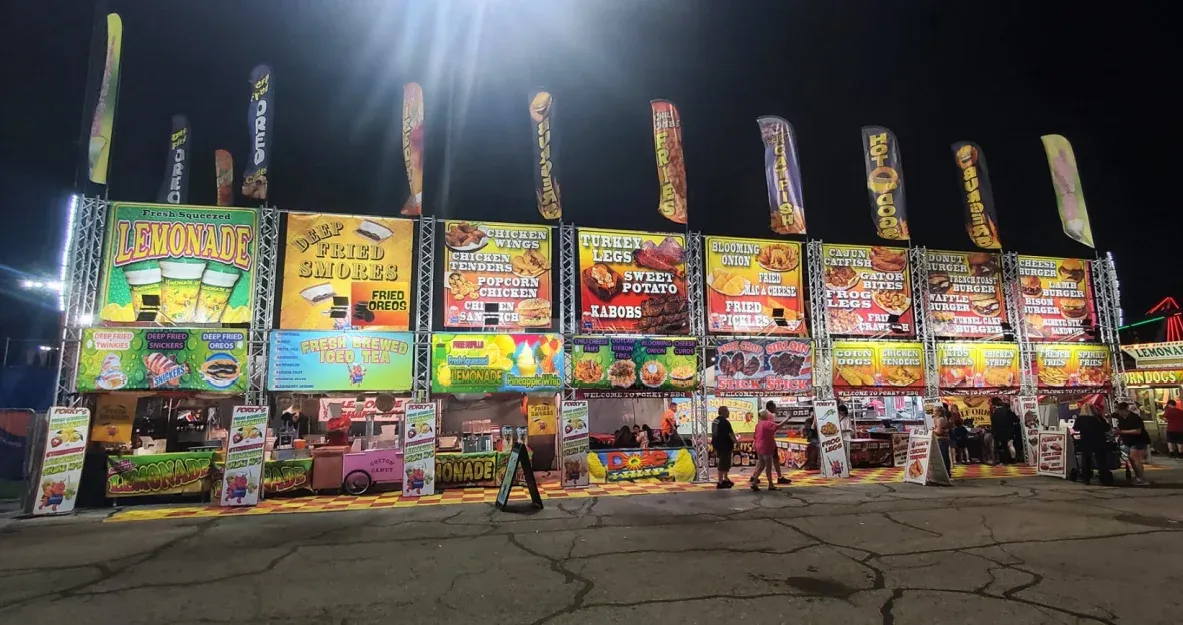
We run up to 8 stands at once across fairs and festivals in 9 states. This guide covers what it actually takes to set one up and run it well, from the space you ask for to the hours you staff. It is written for vendors. If you organize a fair, read how to choose food vendors instead.
What a concession stand is
A concession stand is a self-contained food unit that sells at an event: a trailer, a truck, a booth or a cart. The best ones are built around one idea people can read from 50 feet away, such as lemonade, steak dinners or Korean corn dogs. The stand brings its own cooking, cold and hot holding, handwashing and wastewater, and connects to the event's power and water.
Pick the right space
Fairs sell space by frontage, the length of the side facing customers, and depth.
- Frontage includes everything. Fairs count the hitch, awnings, steps and open doors. A 22 ft trailer can need 26 ft of frontage.
- Standard is about 20 ft. Ten feet is a workable minimum for a booth or a small stand. Our Mega Stand takes 30 to 100 ft.
- Know your serving side. Many trailers serve from the passenger side only, which decides which way you park.
- Location beats size. A smaller spot near the grandstand, the barns or the main gate usually outsells a bigger spot at the end of a row.
Power and water
Utilities are where setup days go wrong. Order them on the application, in writing.
- Electric. A full cooking stand runs best on 220V/50A (a NEMA 14-50 outlet). It powers refrigerators, warmers, the hood, lights and registers. Plan a way to run on 110V, because not every fair can give you 50 amps. A small stand such as Korean corn dogs can run on 110V/20A.
- Cords. Bring your own heavy-duty extension cords. Some fairs say the hookup can be up to 100 ft away.
- Water. Use a food-grade hose from the event's potable supply, with a backflow preventer. South Dakota and Kansas require one.
- Wastewater and grease. Gray water goes to your onboard tank and is emptied at the event's disposal point. Grease goes in sealed containers to the event's bin or an approved recycler.
- Generators. Some events ban them. Check before you count on one.
Setup and teardown
Arrive the day before. A single stand takes us 2 to 4 hours to level, hook up, stock and check. A multi-stand setup takes most of the day. Use sandbags, not stakes, where the grounds are paved or have buried lines. Before the first customer, check that every cooler holds 41 °F or below and every hot well holds 135 °F or above.
Food safety at the window
Health inspectors visit early and come back. The basics they look for are in the FDA Food Code, which most states adopt:
- A handwash sink with soap and paper towels, separate from the 3-compartment sink.
- Hot food held at 135 °F or above and cold food at 41 °F or below, with a thermometer in every unit.
- Meat cooked to temperature: whole cuts like steak and pork chops to 145 °F, ground beef to at least 155 °F (we take burgers to 165 °F), chicken to 165 °F.
- Sanitizer at the right strength, with test strips on hand.
- Food from approved suppliers, stored at least 6 inches off the floor.
- A certified food protection manager on the crew. Ours is ServSafe certified.
Staffing and peak hours
Most of a fair day's sales come in a few rushes: lunch, dinner and after the grandstand show. We staff each stand with 2 to 4 people and add hands for the rush.
- Split the jobs. One person takes orders and payment, one cooks, one assembles and hands out. Nobody does everything.
- Prep before the rush. Cut, portion and stock in the slow hours so the rush is only cooking and serving.
- Take every payment. Cards and phone payments move lines faster than cash.
- Keep the menu short. A short menu is faster to cook and faster to order from.
Hiring and keeping a crew for a whole season is its own job. Mobile Food Experts covers it in Hiring Concession Stand Staff.
Build a menu that sells
Pick a theme and a hero item, then add one or two sides and a drink. Fresh-squeezed lemonade sells on every one of our stands, in every kind of weather. Look at what the fair already has and bring what is missing. For ideas, see our 50+ fair food menu ideas. For pricing, see Concession Stand Menu Pricing.
Signs and looks
Fairgoers decide in seconds. Big, bright banners with photos of the food, the price board where people stand in line, and lights for the evening crowd all sell food. A clean, well-lit stand also tells the fair board you will be an easy vendor to have back.
Paperwork to have ready
- Certificate of insurance naming the event. $1,000,000 per occurrence general liability is the usual minimum, and some state fairs require more.
- The temporary food license from the county or state health department, applied for before their deadline.
- Sales tax registration in the event's state.
- Photos of your stand, your menu and your booth size for the application.
Mobile Food Experts explains the insurance side in Concession Business Insurance, and the application side in How to Get Approved for State Fairs.
Final thoughts
A successful stand is mostly preparation: the right space, utilities ordered in writing, a crew split by job, and a short menu that fills a gap. Get those right and the rush takes care of itself. Starting from zero? Mobile Food Experts has a full guide to starting a concession stand business.

Nearly 20 years running fair and festival concessions across 9 states. MBA, University of South Dakota. Keynote speaker for NICA and IAFE.